Seminar Home
 
This document accompanies the Solari audio seminar Beyond Socially Responsible Investing Part II – Solari Portfolio Strategy. In this seminar, Catherine walks you through two sample portfolios owned by the same hypothetical family – the first is a typical $1mm portfolio before Solari Strategy, and the second is that same family’s $1mm portfolio repositioned according to Solari Portfolio Strategy. Catherine concludes with a side-by-side summary comparison of the two.

Characteristics:
1. Investing in securities of large corporations and governments which – as a system – are financially dependent on a low/falling Popsicle Index;
2. Generating yield, as opposed to building financial equity;
3. Absence of knowledge and understanding of who and what our money is supporting;
4. No risk assessment or strategy for worst-case scenarios; and
5. No diversification – entirely dependent on US federal credit and centralized Tapeworm system

Homebase & Financial Profile:
$500,000 Home in suburbs/$350,000 fixed-rate mortgage, 30-year mortgage with 25 years-to-go
$350,000 Shore condo/$300,000 variable-rate mortgage, $50,000 2nd mortgage from seller, balloon in 5 years

Net Home Equity:
$150,000

Annual Income of Spouses:
$125,000 Full-Time Consulting w/ health care
$50,000 Part-Time Freelance

Note: Both work for large companies dependent on government credit, contracts and purchases

Annual Expenses:
$160,000

Annual Savings:
$15,000 plus reinvestment of portfolio yield


View Portfolio A Details
 

Characteristics:
1. Using rising Popsicle Index of Homebase, family and friends as a navigation tool to find investment opportunities;
2. Decreasing dependency on US federal credit and centralized Tapeworm system; and
3. Focus on building living and financial equity, rather than yield

Homebase & Financial Profile:
See supplemental document: Eight Criteria for Choosing Your Homebase
$190,000 - No Debt – Moved to 30-acre farm in rural farming community
$110,000 - No Debt – Improvements to farm (view details)
Significantly greater natural beauty of home and surroundings; greatly reduced
carrying and maintenance costs; less need for weekend/vacation home - homebase is
close to parks and outdoor recreation

Net Home Equity:
$300,000 - No Debt

Annual Income of Spouses:
$75,000 Full-time consulting w/health care
$25,000 Part-time freelance
Working for clients who are less dependent on government contracts and programs

Annual Expenses:
$75,000

Could cut back quickly to $50,000 if needed, thanks to investments in homebase to increase self sufficiency. Having the time and resources to learn new skills as both income earners are working fewer hours outside the home

Annual Savings:
$25,000
Now saving $25,000 a year, rather than $15,000

View Portfolio B Details


  PORTFOLIO A
Before Solari Portfolio Strategy
PORTFOLIO B
After Solari
Portfolio Strategy
Shifting Toward
Financial Profile  $170,000 - Income (Tapeworm)
$160,000 - Annual Expenses
$15,000 - Annual Savings
$700,000 - Mortgage Debt
$100,000 - Income (self-employed)
$75,000 - Annual Expenses
$25,000 - Annual Savings
$0 - Mortgage Debt
• Greater financial freedom: self-employed, debt free, saving more, continuously reducing overhead
• More focus on wealth-building activities and networking
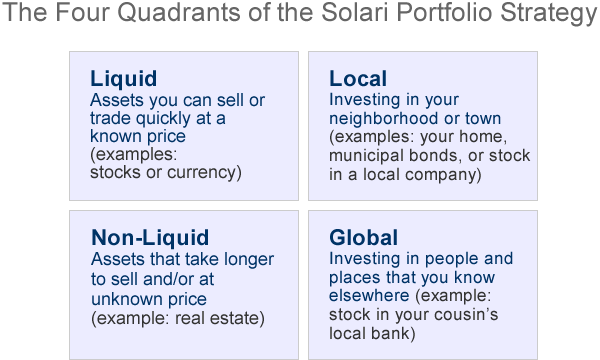
Local Non-Liquid $150,000 TOTAL
$150,000 Homebase Equity
$550,000 TOTAL
$300,000
Homebase Equity
$95,000 Finance Home Mortgage
$5,000 Finance Credit Card
$150,000 Direct Local Invest and Solari Investor Circle
• More equity in home with no debt
• Reducing expenses, increasing self-sufficiency and amenities
• Building wealth locally through disintermediation, emphasis on Popsicle Index and networking
Local Liquid $25,000 TOTAL
$25,000
Local Schools
$75,000 TOTAL
$45,000 Cash, CDs, bank accts, silver and gold coins
$25,000 Stocks local companies
$5,000 Local Municipal Bonds
• Keeps money in the community, supporting local independent banks.
• Builds wealth locally by supporting local businesses and services
Global Non-Liquid $0 TOTAL
$0 None
$200,000 TOTAL
$100,000 Bullion in Europe
$90,000 Land/cottage Central America
$10,000
Angel investments
• Diversifying into more areas with high Popsicle Index
• Working through family and networks of trust
Global Liquid $825,000 TOTAL
I-FIXED INCOME
$225,000
A. US Govt
$150,000
B. Global Gov't
$50,000 
C. Corporate
$150,000
D. Bank CDs
$35,000 
E. Short Term & Cash

II-EQUITY
$75,000 Stocks (Tapeworm)
$40,000 Energy Fund
$100,000 SRI SI Equity Funds

$175,000 TOTAL
$25,000
Digital Gold & Silver
$75,000
Money Market in high Popsicle Index places
$25,000
Local Baskets
$50,000
Stocks that increase Popsicle Index
• Pulling out of the Tapeworm Economy
• Liquidity in sound currency.
• Expanding networks of trust
• Diversifying into more places and their local businesses
• Investing in more business leaders whose products and services are designed to raise the Popsicle Index.


Notes: *Money Market funds reserved for expected
improvements and Micro Equity in Central America


  PORTFOLIO A
Before Solari Portfolio Strategy
PORTFOLIO B
After Solari Portfolio Strategy
Additional Analysis SUMMARY: A focus on yield. Debt based, higher liquidity ratio; appearance of diversity gives false sense of security; dependence on tapeworm and a falling Popsicle Index (increased risk). You are a remote investor -- not building networks of trust or knowledge about solutions.

• Investment in securities of large corporations and governments which -– as a system -– are financially dependent on a low/falling Popsicle Index.

• Yield Generation, as opposed to financial equity building

• Absence of knowledge and understanding of who and what our money is supporting

• No risk assessment or strategy for worst case scenarios

• No diversification – entirely dependent on US federal credit and centralized Tapeworm systems
SUMMARY: A focus on concrete assets, long-term capital gains and a rising Popsicle Index. Equity based (no personal debt), lower liquidity ratio (much stronger liquidity in worst case), true diversity, more protected on the downside (reduced risk). You are a financially intimate investor -- you know and are known by the people you invest in. Building networks and knowledge lays foundation for growing much more significant wealth (greater upside potential); greatest risk is choosing wrong homebase

• Using rising Popsicle Index of homebase, family and friends as a navigation tool to find investment opportunities

• Decreasing dependency on US federal credit and centralized “tapeworm” systems

• A focus on building living and financial equity rather than yield

In Terms of
The Five Legs of
the Solari Model
Puts Our Wealth at Risk by Financing a System with These Characteristics:

I. Fiat currency
II. No privacy of our personal finances; no transparency of govt or non-profit finances
III. Debt based
IV. Centralization of economic and political power
V. Yields reaped from a falling Popsicle Index
Secures Our Wealth by Financing:

I. Sound currency
II. Privacy of our personal finances; transparency of government and non-profit finances
III. Equity based
IV. Decentralization of economic and political power
V. Personal responsibility for a rising Popsicle Index


-- View / Print a PDF version of this document --


Download MP3   |   Seminar Outline    |   Reading List    |   Portfolio Eval    |   Post Questions

 
Seminar Home >>


Disclaimer: Nothing said in a Solari seminar should be taken as individual investment advice. Anyone seeking investment advice for his or her personal financial situation is advised to seek out a qualified advisor and provide as much information as possible to the advisor in order that such advisor can take into account all relevant circumstances, objectives, and risks before rendering an opinion as to the appropriate investment strategy.

The successful application of any portfolio strategy requires sound business practices, including thorough due diligence, the application of good business and investment judgment as well as attention to ongoing performance, diversification and risk management and the patience to work through and learn from investments that are not successful.